
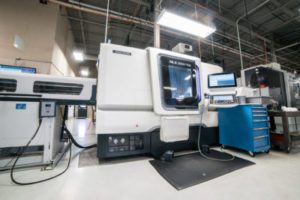
 Providing 5 Axis machining of space components requires experience and skill to produce many varied complex shapes to very tight tolerances. Initially these type of parts were machined on a combination of two-axis lathes and three-axis mills. Depending on part complexity and tolerance callouts many of the parts required elaborate fixturing and multiple setups. Thanks to advances in machine design, more powerful machine controllers , quicker responding servos and software, and better tooling technology, we can now accomplish complex 4- and 5-axis simultaneous machining, reducing the number of setups, which helps eliminate error stack-up.
Defining 5-Axis Machining
Traditional CNC machines move in two linear axes (X and Z) for lathes and three linear axes (X, Y, and Z) for milling machines. The “5-axis” refers to the number of directions (axis movements) the cutting tool or workpiece can move via machine slide or turret movements. On a 5-axis machine, the cutting tool moves across the X, Y, and Z linear axes, as well as rotates on the A and B axes to approach the workpiece from almost any direction.
Ther advantages in utilizing 5-axis CNC machines versus a combination of two/three-axis machining is as follows:
Fewer Setups
You can approach the workpiece from multiple directions. Cutting action can be achieved in 5 axis simultaneouly. This capability can greatly reduce the number of setups required. It also simplifies the need for elaborate workholding or special fixturing.
Improved Tool Life
Improved tool life and cycle time reduction can result. By being able to tilt the tool/table or turret, you are able to to optimumize cutting position (chip relief), maintain constant chip load and eliminate chatter, all helpful for maximizing tool wear.
Complex Shapes
A major advantage of five-axis machining is the ability to machine most complex shapes. The additional movement creates machining angles and arcs for the cutting tool that maximize cutting conditions and also provide for optimum chip relief.
Increased Relational Accuracy
Having to move the part into different chucking positions creates imprecision and tolerance stackup. Fewer chuckings and less re-fixturing helps produce more precision in the parts. By using the same “zero” or “home” location, feature-to-feature accuracy is improved.
3+2 Axis Machining
There are parts that can only be machined with simultaneous 5-axis movement. But not all 5-axis parts require full 5-axis simultaneous machining. Some 5-axis parts are best machined utilizing a 3+2 movement.
In 3+2 machining, the fourth and fifth axes are used to locate the work piece (or cutting tool, depending on the type of machine) in a fixed position for cutting tool access. In the past, the same tool paths could have been achieved in a three-axis machine, but only after loading and unloading between multiple setups, fixtures, or machines. Bu utilizing five-axis machines it can increase uptime (spindle utilization), minimize and thus decrease human error, and eliminates the need for special fixtures. For parts with features or holes on multiple faces or angles, 3+2 machining is the clear choice.
Better Surface Finish
On 5-axis machines, by rotating the fourth and fifth axes, the part can be orientated to bring it closer to the cutting tool. Getting the part closer to the cutting tool allows for reduction in the length of the cutting tool. A shorter cutting tool is more rigid, less susceptible to vibration, which can have a direct impact on achieving better surface finish.
As technology advances, so does the market’s expectations for higher quality products while maintaining or reducing unit pricing. To meet this challenge, Intrex has made significant investments in multiple-axis equipment as well as systems software to oversee and control our entire manufacturing process.
We would welcome an opportunity to speak to you about addressing your supply chain needs.
