
Twin-Spindle and Turn-Mill Technology
Jul 24, 2026Twin-Spindle and Turn-Mill Technology That Reduce Lead Times and Improve On-time Deliveries
In today’s competitive manufacturing environment, reducing lead times is essential for meeting customer expectations, improving profitability, and staying ahead of the competition. At Intrex Aerospace we know that the best way to address more complex product designs and tightening production schedules is continued investment in advanced machining solutions that combine multiple operations into quicker setups. One of the most effective methods for increasing efficiencies is investment in twin-spindle and turn-mill technology that reduce lead times and improve on-time deliveries.
Twin Spindle Technology
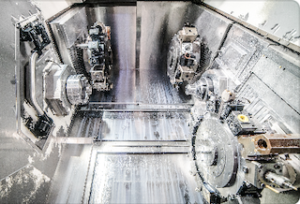
Twin-spindle technology allows a machine to perform operations on both ends of a workpiece, requiring limited manual intervention and reducing or eliminating secondary setups. Our Okuma LT 3000EX MY 7 axes have twin spindles and twin turrets servicing each spindle. The 2 turrets have 12 positions per turret; both turrets have turning, live milling and a “Y” axis.
The way the machine functions is after the primary spindle completes the first series of machining operations, the secondary spindle automatically receives the part and continues machining the opposite side. This seamless transfer eliminates the need to remove, reposition, and manually re-clamp the component, eliminating manual handling time while improving dimensional accuracy. By completing both sides of a part in one continuous process, we significantly reduce overall production time and minimize the risk of alignment errors.
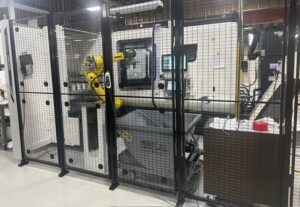
To further enhance machine efficiency and capability, the LT 300EX MY is also fitted with a Fanuc 6 axis robot for load/unload (we will address additional automation later in this article).
Turn-mill Technology
In addition to the above-mentioned Okuma twin spindle, we have invested in multiple DMG Mori NTX/Z series machine tools, all with turn/mill capability. Most of our machines have some level of automation. Some of our machines are fitted with ATC’s (automatic tool changers) with 40/60 tool carousels. The upper turrets are designed to accept both milling and turning tools. Our NTX 2500 5 axis simultaneous with HSK 63 12,000 RPM spindle can accommodate the most robust milling applications.
Our latest machine purchase with an Oct. 2026 delivery is a DMG Mori NZ Tre twin spindle that can accomplish 6-sided complete machining in two independent working areas. The machine design accommodates “Y” axis on the lower turret that can access both left and right spindles. It will also have a Fanuc robot for load/unload.
The value propositions our DMG Mori machines offer is their design integrates turning and milling into a single machine platform. These turn-mill machines perform turning, milling, drilling, tapping, and other machining operations in one setup, allowing complex parts to be completed without multiple machine transfers. This integrated approach streamlines production while maintaining consistent quality throughout the manufacturing process.
Setup Reduction
One of the most significant advantages of combining twin-spindle and turn-mill technology is the reduction in setup time. Every new setup requires time and if multiple setups are required you introduce opportunities for variation to the process. Setup time also takes away from time dedicated to production. Using twin spindle and turn/mill machines, multiple operations can be consolidated into a single machine cycle. Setup requirements are decreased substantially. Operators spend less time changing fixtures, aligning parts, and verifying dimensions, thus allowing more machine time devoted to productive cutting (spindle utilization).
Because Intrex is a contract aerospace manufacturer lot sizes vary. It is common for much of our production to be high-mix, low-volume. Frequent changeovers are common, and to have minimal setups with accompanying time savings, can have a substantial impact on throughput and cost reduction.
Reduced In-progress Inventory
Conventional manufacturing often requires partially completed components to wait between machining operations. Multiple setups add length to the production process. It can create bottlenecks, adding to carrying and inventory costs. By completing more operations in one machine, parts move quicker from raw material to finished components. Shorter production flows improve scheduling flexibility, simplify inventory management, and enable manufacturers to respond more quickly to changing customer demands.
Quality Improvements
Every time a part is removed from a machine and re-positioned in another setup, there is potential for positioning errors, that may require additional inspection and/or rework and scrap. All adding to the cost. Twin-spindle and turn-mill systems maintain precise workpiece alignment throughout the machining process. This improves repeatability and reduces scrap rates. Higher first-pass yield means fewer delays caused by quality issues and less time spent correcting defects before shipment. Intrex machines have integration with our uniPoint QMS. All this also contributes to shorter lead times.
Automation
Automation capabilities further accelerate production. We have several layers of automation integrated into our twin-spindle turn-mill machines. We have LNS Quik Load bar feeders, Fanuc and DMG Mori robotic loader systems, automated part catchers, in-process part probes and tool presetters. All these features allow machines to operate with minimal operator intervention, extending production into unattended shifts or overnight operation. Continuous machining increases equipment utilization while reducing labor costs and maximizing output from existing manufacturing resources.
Summary
The impact of having these types of machine tools is far-reaching. By consolidating multiple machines into one multifunction platform, it reduces floor space requirements, lowers maintenance costs, and decreases capital investment in additional equipment. Additional benefits are simplified programming, reduced tooling inventories, and fewer material handling steps.
While advanced twin-spindle turn-mill machines require a larger initial investment, rapid returns through improved productivity, lower operating costs, increased capacity, can be achieved. As global competition continues to intensify, we as a contract aerospace manufacturer must find ways to produce higher-quality parts in less time. Twin-spindle and turn-mill technology provide a practical solution to the high standards today’s industries require.
